
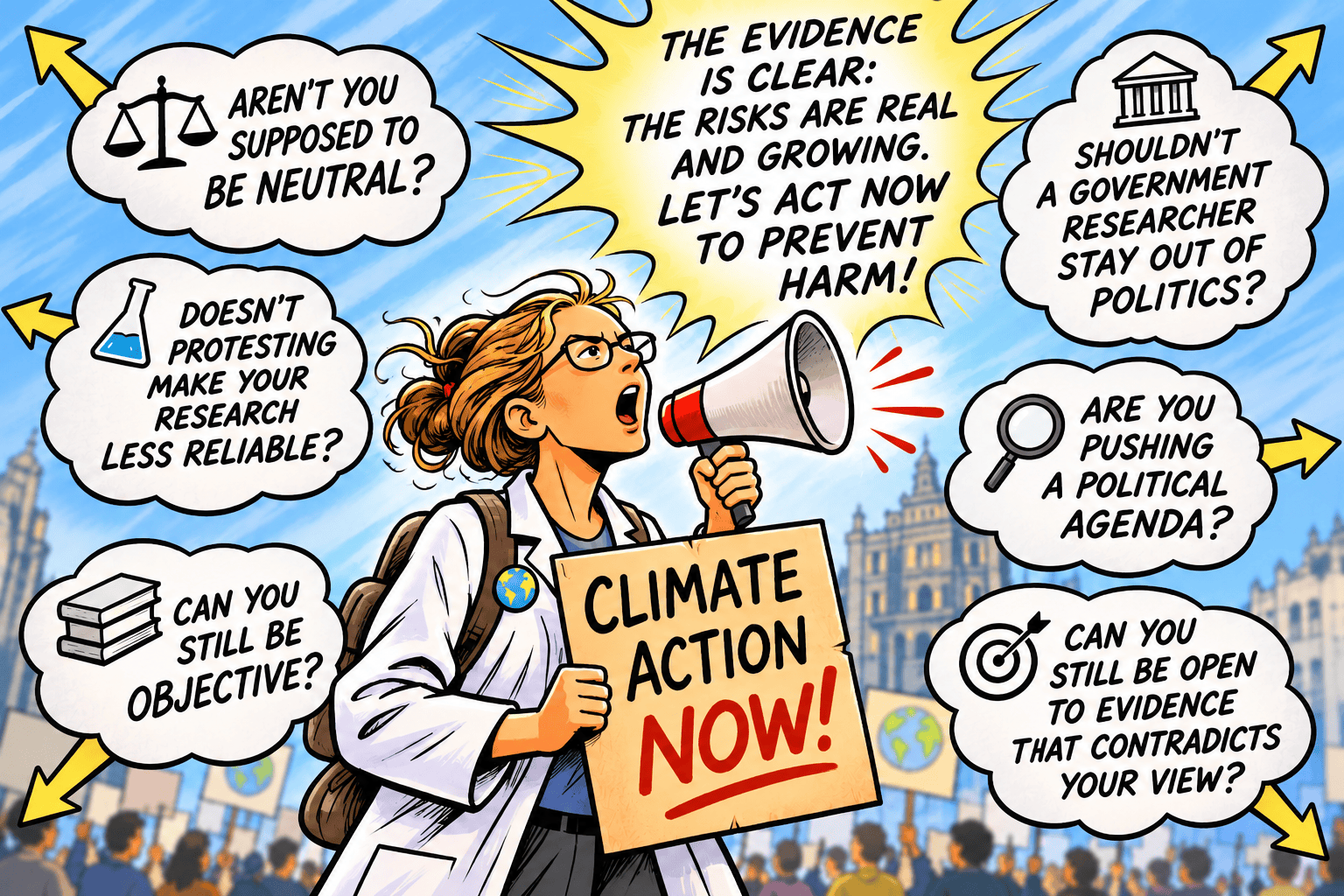
Can a climate scientist join a climate protest and still be considered an objective scientist?
The recently published article Exploring advocacy of Dutch government climate researchers: an interview study in Geoscience Communication explores how scientists working at Dutch government research institutions navigate the tension between scientific independence and public advocacy.
It got me thinking. Where does scientific responsibility end and personal opinion begin?
But perhaps we should ask a different question first. What is neutrality, anyway?
Scientists are people, too
Being a scientist is a job. One that requires years of education, specialised knowledge and experience, but a job nonetheless. Scientists are also citizens. They vote, have opinions and, like everyone else, have the right to protest.
Consider a farmer protesting nitrogen regulations. Even if we strongly disagree with their actions, we wouldn’t suddenly assume they had forgotten how to farm.
Or a doctor protesting government cuts to healthcare. Would their participation in a demonstration automatically make them less capable of diagnosing a patient?
Yet when climate scientists protest insufficient climate action, their scientific objectivity can suddenly become part of the debate.
Why?
What makes science trustworthy?
Science has rules. Not rules about what scientists should believe, but about how they should conduct their research.
Three fundamental principles help explain this:
- Evidence: Scientific conclusions must be based on observations and evidence, not on what researchers would like to be true.
- Reproducibility: Other researchers should be able to examine your methods and reproduce your findings.
- Falsifiability: A scientific hypothesis must be open to being proven wrong. Good scientists don’t just search for evidence supporting their ideas; they actively challenge them.
These principles are essential to trustworthy science.
Notice what’s missing? A requirement to have no personal opinions.
A scientist can be deeply concerned about climate change and still follow these principles. Equally, someone who never attends a protest can conduct biased research.
Scientific integrity is demonstrated through scientific practice, not through political silence.
When did climate change become an opinion?
Human activities are warming our planet. That is a scientific conclusion supported by decades of research.
What society should do about it is a political question. How quickly should emissions fall? Who should pay? Which solutions should we prioritise?
Those are legitimate subjects for public debate.
But the underlying physical reality doesn’t change depending on which political party someone supports.
The study also shows that scientists themselves have different views on advocacy. Some see speaking out as a responsibility, while others worry about its effect on their perceived independence. Both perspectives deserve consideration.
Climate scientists understand the evidence, including the consequences of continued warming. Some feel compelled to speak publicly about those consequences. Others prefer to contribute through their research, teaching or advice.
Neither choice automatically makes someone a better or worse scientist.
Who decides what neutrality means?
We often treat silence as neutrality. But remaining quiet doesn’t mean someone has no opinions. It simply means they aren’t expressing them publicly.
And silence isn’t always considered a virtue. In certain professions and circumstances, failing to warn others about a known danger can be considered negligent, sometimes even punishable by law. We generally recognise that specialist knowledge can bring responsibilities, particularly when people’s safety is at stake.
Climate scientists also study risks to human lives, livelihoods and ecosystems. Yet speaking publicly about those risks can raise questions about their neutrality.
For scientists working at government institutions, there may be additional professional obligations. The study highlights how these can complicate decisions about public advocacy. But I believe we should be careful not to confuse those professional responsibilities with a general expectation that scientists remain silent about their personal convictions.
That doesn’t mean every climate scientist has a duty to protest. Nor does it mean that every form of protest is beyond criticism.
Whether to speak out or remain silent should ultimately be a personal choice, for scientists as much as anyone else. A willingness to speak up about risks to human lives should not, in itself, cast doubt on someone’s scientific integrity.

